Ten minutes.
That’s roughly how long the fastest EVs on the U.S. market may soon spend at a charger. Charging hardware is getting close to the ceiling of what a passenger car needs, and that changes what drivers will care about next.
A national charging network recently previewed a system rated up to 750 kW, which it expects to deliver that ten-minute charge once deployment begins in 2027. BYD goes further, quoting its megawatt flash charging at 10% to 70% in about five minutes.
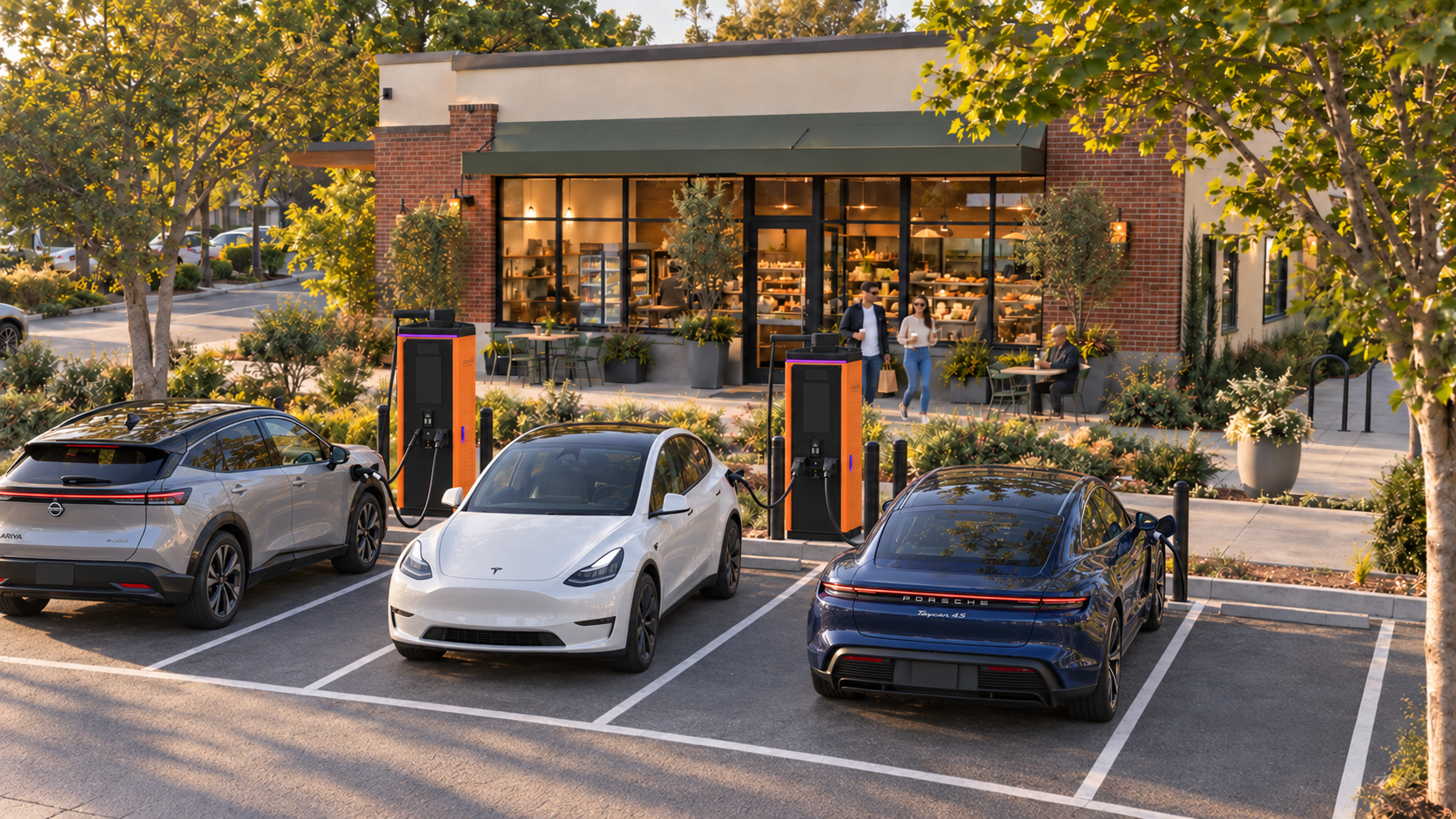
The detail that’s easy to miss is how that power gets used. The network’s design shares power across its dispensers, shifting it toward the cars that can use it. Very few cars on sale today can draw more than 350 kW, so a 750 kW unit isn’t really built for one car. Shared between two charging spaces, it has enough power for two of today’s fastest-charging vehicles to charge side by side at full speed, as long as the power behind the dispensers is there to support it. That’s the version of fast charging drivers will feel: full speed even when the space next to them is busy.
We’re building Rangeway like a hospitality company, so we watch this hardware closely.
Here is what I think it means. When the charge gets this fast, the charger stops being the thing that sets a stop apart.
The place becomes the product.
The Industry Spent a Decade Selling Kilowatts
Charging networks have competed on speed and coverage for years, and for good reason. Speed was the bottleneck. In a McKinsey survey of mobility users across 15 countries, 42% said charging speed was their most important consideration when choosing a public charger.
That race is tightening. The same network says the charge rates it sees have risen nearly 20% in two years, and it expects the trend to continue. The cars will take years to catch up to the newest hardware, because people keep their cars for a long time.
Still, the direction is clear.
Once most networks can deliver a fast, dependable charge, speed stops setting any of them apart.
A kilowatt from one charger is the same as a kilowatt from the next, much as a gallon of regular is the same at every gas station. What can still differ is everything around the charger.
That’s where the real friction is heading.
The Friction Moves to the Minutes in Between
Picture a ten-minute stop from the driver’s seat.
It’s too short to leave and do something else, and too long to sit in the car watching a progress bar. If there’s no restroom, nowhere to sit, and nothing to drink, those minutes are spent standing in a parking lot next to a charging cabinet, whatever the weather is doing.
That’s where the friction goes once the charge itself is quick and reliable. I call it dead time: minutes a driver has to spend somewhere, with nothing useful to do and nowhere comfortable to be.
Ten minutes of dead time in the rain feels longer than forty minutes in a warm lounge with good coffee. Anyone who has done both knows it.
The Data Already Points the Same Way
The research on amenities is consistent. A spring 2026 study by Paren found that charging sites with 11 or more nearby amenities averaged 28 sessions a day, compared with nine at sites with only some nearby amenities. That’s about three times the use. Busy commercial areas would attract more charging anyway, so the study shows an association rather than proof that amenities alone made the difference. The link is still hard to ignore.
UC Davis research for Next 10, published in 2024, points the same way. At average use, it estimated that charging infrastructure can take more than ten years to break even, and it concluded that co-located services and amenities are needed to improve the return. Drivers in that research were 37% more likely to choose a charger near other services than one in isolation.
Our own driver study adds a useful caution. Respondents put reliability and charging speed first, with clean restrooms close behind, and most were willing to pay only a modest premium for a better stop. It was a voluntary sample, so I treat it as a signal. It suggests the value of a good place shows up in where drivers choose to stop and what they buy while they’re there, more than in a higher price for electricity.
A location deserves to be judged by the minutes around the charge as much as by the charger itself.
Ten Minutes Is Long Enough to Be Intentional
This is where we see the opportunity, and where we’ve placed our bet.
Ten minutes is short. It’s also a real window. It’s long enough for a restroom, a fresh coffee, a stretch, and a look at something other than the dashboard. It’s long enough to reset before the next couple of hours of driving.
The design question changes. You stop asking how to minimize the stop and start asking how to make those minutes worth having. That shapes the decisions we’re making for our destination formats:
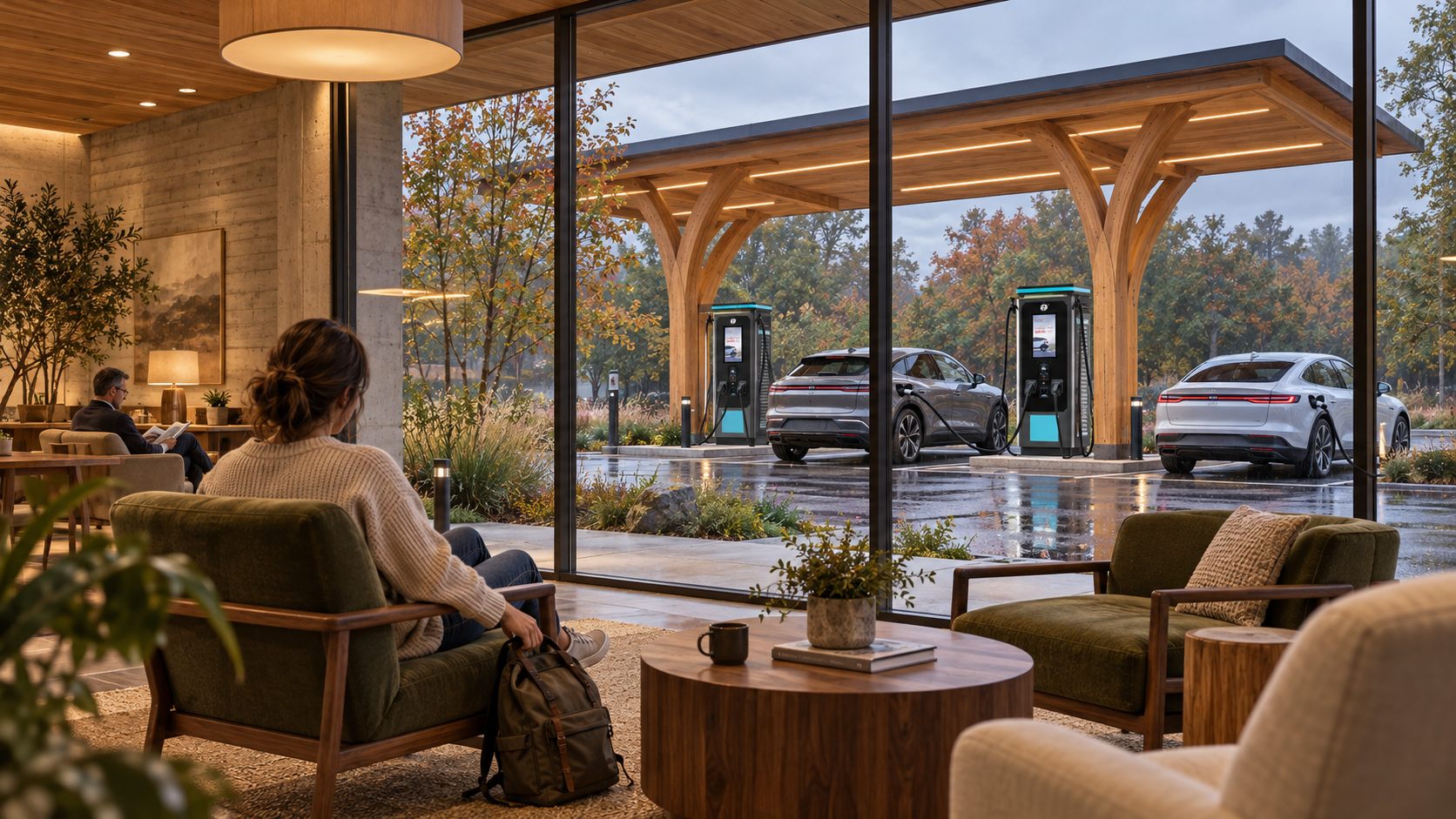
- Indoor comfort comes first. Our Waystations and Basecamps are being designed with a climate-controlled driver’s lounge. A short stop in fog, wind, or desert heat calls for shelter, and a parking lot doesn’t provide it.
- Clean, premium restrooms sound basic. On long drives they’re often missing, and travelers remember the places that get them right.
- Food and drink should be worth stopping for. Waystations are planned with automated retail for something quick. At Basecamps, we plan to curate the space so what you find reflects where you are.
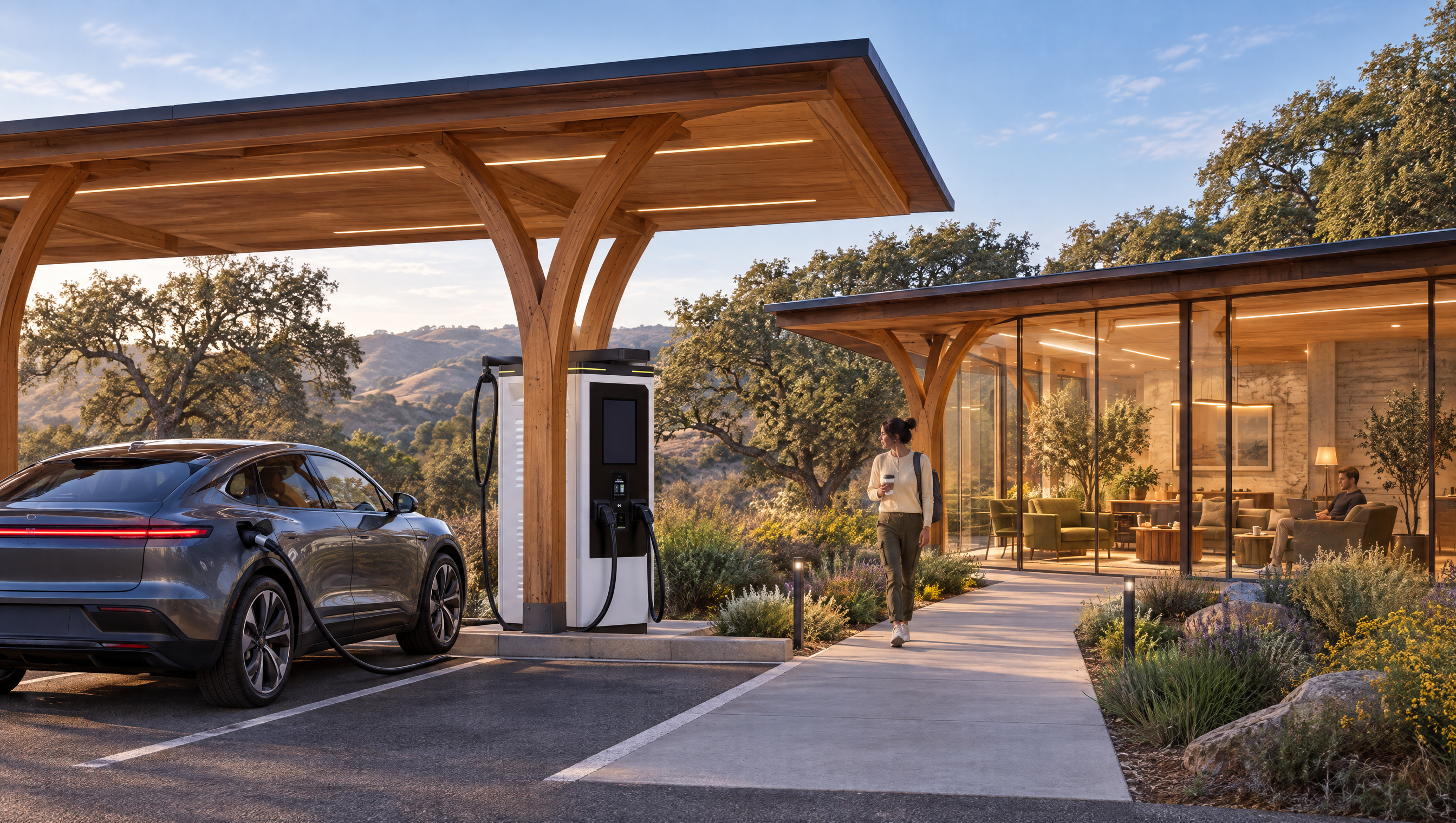
- A sense of place matters, too. Our design direction, California Modern updated for contemporary hospitality, uses warm wood, concrete, comfortable furniture, and a connection to the surrounding landscape. A stop should feel like it belongs where it is.
Faster, shared charging strengthens this approach. When a fast charge is available almost everywhere, drivers can choose a stop based on everything around the charger. The stop with the best ten minutes has the advantage.
What a Ten-Minute Stop Can Earn
From an operator’s point of view, a well-designed ten-minute stop can earn three things.
The first is a transaction. A coffee, a snack, or a bottle of water is small on its own, but it adds up across a year of visits. That revenue matters when charging alone can take a decade to pay back.
The second is a memory. A warm lounge, a clean restroom, and a window with something worth looking at are the details travelers mention to each other. Word of mouth is the least expensive way to bring in new guests, and it’s built one good stop at a time.
The third is a return visit. A driver who enjoyed a stop once is more likely to plan the next trip around it. Repeat visits drive utilization, and utilization drives nearly everything else in the economics of a site.
The Faster the Charge, the More the Place Matters
We welcome faster charging. It removes one of the last practical barriers to electric road trips, and road trips are a big part of why Rangeway exists.
The hardware will keep improving, and over time it will become broadly similar from one network to the next. When that happens, a charging stop will be judged the way a hotel or a restaurant is judged: by how it made you feel while you were there.
Ten minutes is a short stop. It’s also a real chance to give a traveler shelter, a good cup of coffee, and a place worth remembering.
We intend to earn every one of those minutes.