By Zak Winnick
Most charging projects don’t die in zoning. They die in the queue.
Talk to anyone who has tried to build a DC fast charging site in the last three years and you’ll hear the same story. The land is fine. The capital is in place. The hardware is sitting in a warehouse somewhere, ready to ship. Then comes the utility timeline. Eighteen months becomes twenty-four becomes thirty. The transformer everyone is waiting on is on backorder. The interconnect study is in queue behind two hundred other projects. The substation upgrade got pushed to next budget cycle. The local utility planner is one person doing the work of three, and your project is number forty-seven on a list that doesn’t move.
This isn’t an edge case. It’s the median experience. Networks that announced ambitious deployments two and three years ago are quietly missing their site count targets, and the reason almost always traces back to power availability rather than to anything they’re willing to put in a press release.
The industry has gotten very good at talking about the things in front of the meter, like plug standards, pricing transparency, driver experience, and reliability scores. All of it is real. All of it is worth fighting about. The conversation that’s gone quiet is the one that determines whether any of those other things ever matter, which is whether the power gets to the parcel in the first place.
There’s a reason it’s gone quiet. The utility-side answer doesn’t have any heroes. Operators don’t want to admit they’re stuck behind a process they can’t influence. Regulators don’t want to admit the system they’re supposed to oversee can’t move at the speed of the transition they’re asking for. Utilities themselves are in an impossible position, asked to support a load profile they were never designed for, on capital cycles that take a decade to turn over. So everyone talks about something else. Charger reliability is a real and important conversation, but it’s also the one available conversation that doesn’t require anyone to admit the harder one.
That’s the story underneath every charging announcement you’ve read in the last twelve months. It’s also the reason most of those announcements quietly slip a year or two before anyone notices.
The good news is that the math has finally changed.
Battery costs have come down faster than almost anyone modeled them coming down. Lithium-iron-phosphate chemistries that were exotic five years ago are now standard for stationary storage and are still falling in price. Solar canopy economics that needed federal incentives to pencil now pencil on a clean unsubsidized stack in good sun states. Inverters, balance-of-system components, and the engineering integration costs that used to make off-grid sites bespoke and expensive are now procurement. The whole stack has commoditized. Off-grid DC fast charging stopped being a thought experiment somewhere between 2023 and 2025, and most of the industry is still catching up to that.
What that means in practice is that for the first time, an operator can choose where to build based on where drivers actually need power, rather than where the utility is willing to deliver it. That’s a different game. The map of viable charging sites stops being defined by feeder capacity and starts being defined by traffic, geography, and demand. Whole stretches of road that were written off as too remote, too far from a substation, too expensive to interconnect, become buildable, and not eventually but now.
Which is part of why we’re starting where we’re starting.
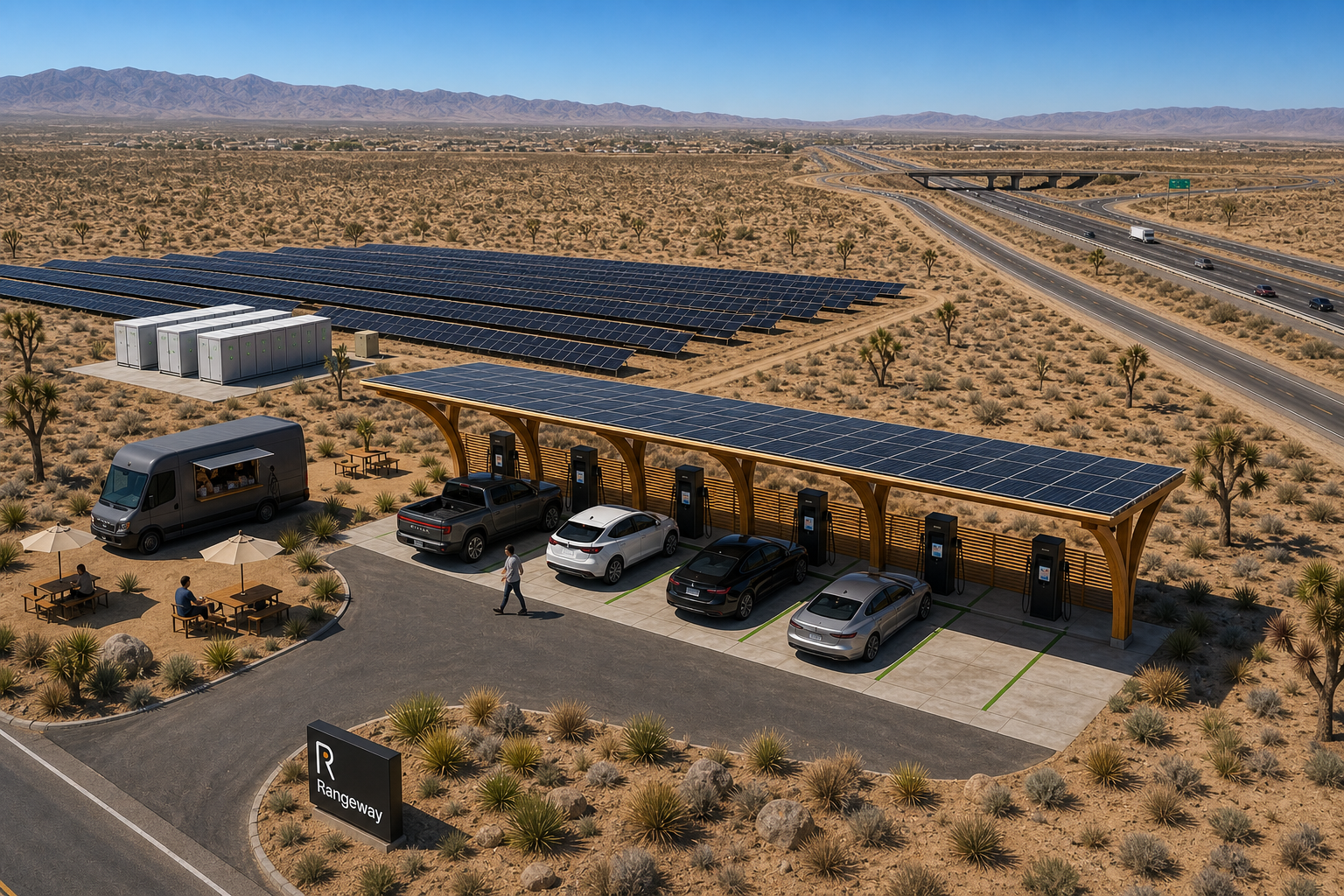
The first Rangeway location is going in the ground in a place where the grid was never going to be the fast answer. The closest meaningful interconnect is far enough away to make a traditional build a multi-year project. The solar irradiance is among the best in the country. The traffic is real and growing. The math runs the other direction. A solar canopy goes overhead, a dedicated solar field sits on the property, battery storage carries the load when the sun is down, and the chargers run off all of it. There is no substation upgrade waiting on a utility budget cycle. There is no interconnect queue. There is no compromise on the charge curve when a driver pulls in on a hot afternoon needing real power.
The system is also faster to build. The interconnect application that would normally consume the first eighteen months of the project schedule is gone. The civil work, the structural work, the solar installation, and the storage commissioning happen on a timeline the project controls, not on a timeline a utility planner controls.
That’s not a sustainability talking point. It’s an operational decision. The cars get charged, fast, every time, in a place where the alternative was waiting until 2028. The experience starts with power that actually works, not power that worked at commissioning and started throttling six months later because the local feeder wasn’t ready for the load. Reliability stops being something you bolt on after the fact with redundant hardware and remote diagnostics. It becomes part of the architecture. The system was designed to deliver real power every hour the sun is shining and every hour after.
This is going to be the dividing line in the next chapter of the industry. It won’t be who has the most ports. It won’t be who paid for the most renders. It won’t be who has the prettiest map. It will be who can put real power in the places drivers actually need it, on a timeline that matters, without the grid as a single point of failure. The networks that figure this out are going to spend the next five years building. The networks that don’t are going to spend the next five years explaining to their investors why their pipeline keeps slipping.
Our first site will be the proof of all of this. The foundation goes in soon, the chargers come online in early 2027, and there are more sites behind it that we’re not ready to name yet.
If you want to follow the build, subscribe to Field Notes at fieldnotes.rangeway.co. If you’re building toward the same thing, working in this space, or thinking about backing what comes next, we’d like to hear from you. Reach us at hello@rangeway.co.